

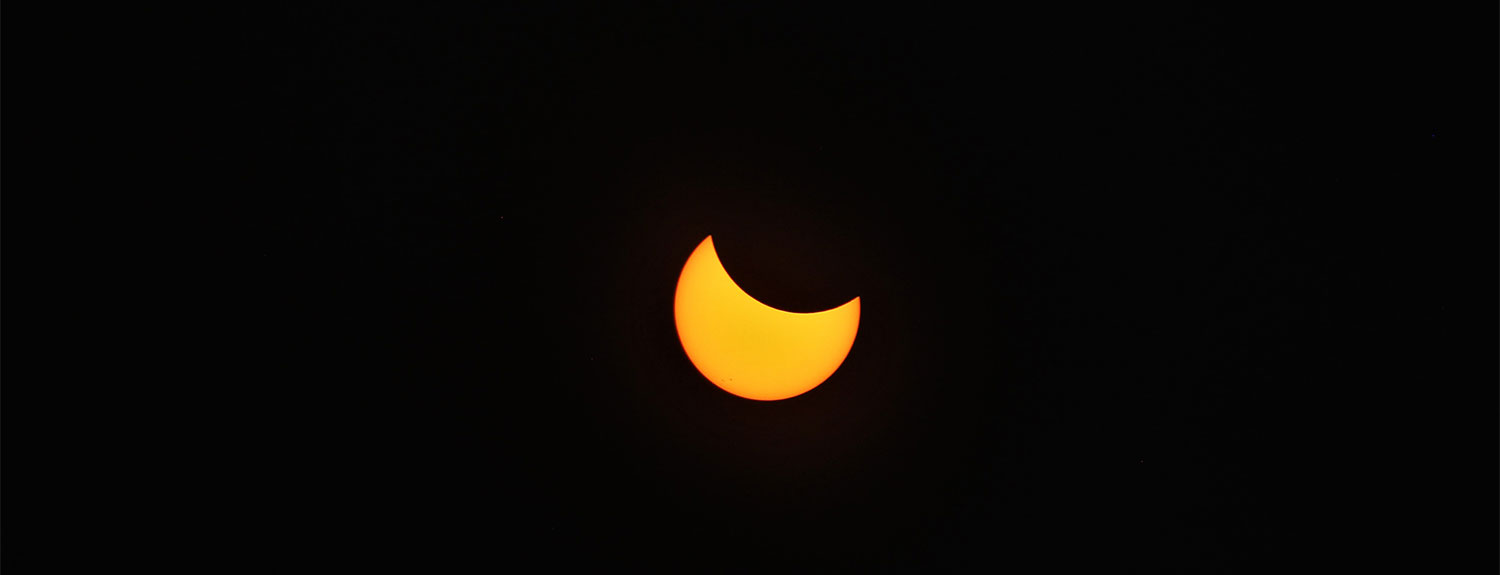
Eclipse at the Bell Museum
Join our astronomy team at the Bell Museum for opportunities to view two solar eclipses.
We’re wrapping up a Solar Big Year with a total solar eclipse in 2024! A total solar eclipse is when the Moon completely blocks the Sun.

From left to right, these images show a total solar eclipse, annular solar eclipse, and partial solar eclipse. Credits: Total eclipse (left): NASA/MSFC/Joseph Matus; annular eclipse (center): NASA/Bill Dunford; partial eclipse (right): NASA/Bill Ingalls
Join us at the Bell for a special open Monday to celebrate Minnesota’s partial view of the eclipse on Monday, April 8, 10am-4pm. The eclipse will be at its peak at about 2:00 pm, and we’ll see about 75% coverage here in Minnesota. Throughout the day, we’ll have a plethora of solar focused activities, a livestream of the eclipse, a new eclipse flipbook pattern, and expert astronomy staff to answer all of your solar questions!
Please note: we’re unable to control the clouds — if the weather is poor on the day of the eclipse, we’ll still have a day of sun-focused activities!
Please be aware that we expect large crowds. All children under 18 must be properly supervised. Our guideline is at least 1 adult per 8 children.
This is a public event and we are not accepting group visits for our eclipse programming. We will not be able to accommodate buses, and do not have the infrastructure and staffing to support group needs on this day.
Please see our educator resources page for ideas on how to learn about and watch the eclipse with your class from your school!
In-Person Activities

Find additional solar observing dates at the Bell Museum
Solar observing
-
Planetarium shows
Ticketed Read MoreCheck out a planetarium show about eclipses!
10:30 AM
Totality
11:30 AM
The Sun: Our Living Star
12:30 PM
Totality
1:30 PM
NO SHOW
2:30 PM
The Sun: Our Living Star
-
Outdoor activities
FreeBig Sun, Small Moon
How does the Moon completely block out the Sun during a total solar eclipse? Is it science? Math? Coincidence? Or ALL THREE? Find out by modeling how the Earth, Sun, and Moon line up, while you wait in line at the telescopes!Ask our Experts!
Stop by our interpretation station to ask our experts all of your burning questions about the Sun, the Earth, and everything in between!Sun Safety — Make a UV Detector
How can you protect yourself from the Sun’s harmful ultraviolet rays? We’ve all heard that sunscreen and Sun protective clothing can keep your skin safe, but at this station you’ll see just how well these and other methods work using UV-light sensitive beads.Pinhole Projection Station
Sunlight going through any small hole projects a clear outline of the eclipse onto a flat, light colored surface. We’ll get creative by using everyday objects to safely see the eclipse. Remember: NEVER look at the sun through the holes!Solar Observing
While we’re safely watching the Moon cover the Sun, it’s a good time to see what’s happening on the Sun’s surface! With solar filters on our telescopes we’ll see if there are any good sunspots showing up on this eclipse day. -
Come inside the museum
Included in gallery admission Read MoreEclipse Flip Book
Make your own flip book of the path of the eclipse in our skies to commemorate the day!Investigate Eclipses
Explore how eclipses occur by getting hands-on with a giant model of the Sun, Moon, and Earth!Streaming the Eclipse
We won’t see the full, total eclipse outside in Minnesota — but inside, we’ll be streaming a view of the eclipse from one of its peak locations!
Visit Our Galleries!
Minnesota Journeys and the temporary exhibit Moments of Memory: Minnesota Landscapes Painted from Life will be open.
Solar safety
- Our telescope equipment utilizes safe Sun viewing methods; filtering the sunlight and projecting the sunlight.
- Solar filters include white light filters that block 99.999 percent of incoming sunlight, safely allowing us to see any sunspots that might be visible.
- H-alpha SolarMax II telescope filters out all the colors of sunlight except a specific red light (656nm) to allow us to see features such as solar prominences along the edge of the Sun.
- Sunspotters use a different method to safely view the Sun. They utilize mirrors and lenses to project the Sun safely onto a screen (piece of paper). You can draw/trace your own Sun and sunspots to start your own solar data log.
Parking
- Paid surface lot parking, managed by UMN Parking & Transportation Services, is available with an entrance off of Larpenteur Ave. The daily rate is $6. Note: The parking fee is waived for any vehicle in the lot under 10 minutes. Pay stations only accept credit cards.
- The St. Paul campus circulator is a complimentary bus that runs every 20 minutes and drops off in front of the Bell. Please see the website for route and stop details.
- A complimentary, accessible shuttle will be traveling between these off-site locations and the Bell entrance from 10am–4pm.
- UMN Lot #101
2065 Commonwealth Ave, Falcon Heights
(paid parking) - UMN Lot #171
1532 Cleveland Ave N, St. Paul
(paid parking)
Shuttle will pick up on the corner of Cleveland and Dudley - UMN Lot #175
2067 Dudley Ave, St. Paul
(paid parking)
Shuttle will pick up on the corner of Cleveland and Dudley
- UMN Lot #101
Minnesota’s Astronomy Classroom programming is generously supported by
