

Solar Eclipse Educator Resources
Monday, April 8, 2024
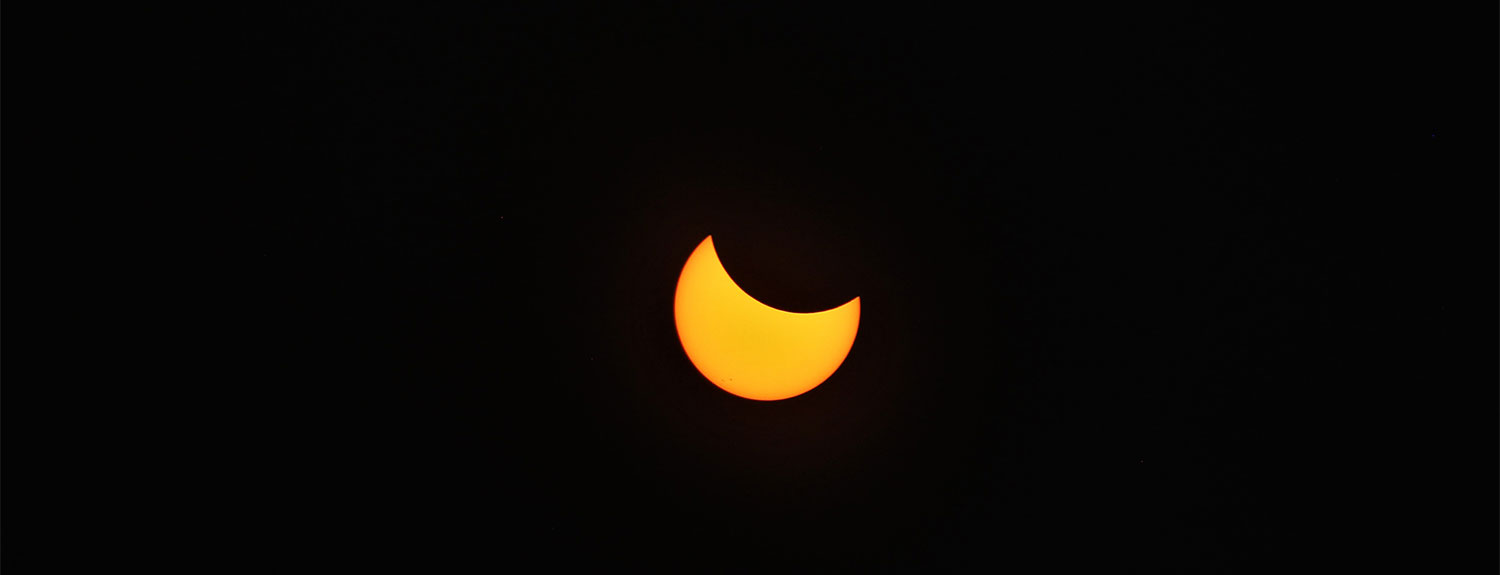
On Monday, April 8 there is a total solar eclipse visible across the US from Texas to Maine. In Minnesota, we will see a partial eclipse. In St. Paul it will last from 12:48 to 3:15 pm, with the peak at about 2:03 pm, and we’ll see about 79% of totality. Find out the exact timing for your location here!
This is a great opportunity to share this phenomenon with your students! Here are some fun ways to learn and teach about eclipses.
Please note: We are hosting an eclipse program for the general public. We are not accepting school group visits. We will not be able to accommodate buses, and do not have the infrastructure and staffing to support group needs on this day.
Safety
Never look directly at the Sun! Even just a quick glance can cause eye damage. Tools such as eclipse glasses or a telescope with a proper filter are necessary to make viewing safe. The ideas below can help!

Glasses
If you have eclipse glasses on hand, help children in your care use them safely. They should put the glasses on while looking away from the Sun, then look toward the Sun only when their eyes are safely covered.
Purchase eclipse glasses from a reliable vendor, not websites that don’t specialize in solar viewing. Put your orders in early!
Pinhole Projections
Ages 8+, 20-40 minutes.
A safe way to view the eclipse without glasses is to use pinhole projection.
Maps and Animations
Where and when can you see the eclipse?

View an animation of the path of the eclipse.
Find the exact timing of the eclipse in your city!
Are you planning to travel? Look up the weather conditions in cities along the path of totality to help you decide where to go.
Activities
-
Eclipse Chalk ArtRead More
Make your own artistic representation of the Sun’s corona, the outermost layers that are only visible during an eclipse.
- All grades. Younger children may need assistance with making a circle, or have a pre-cut circle provided for them
-
Sidewalk Shadow TracingRead More
Learn about the Earth’s rotation by tracing your own shadow.
- All grades
-
Make a SundialRead More
Learn how following the Sun’s shadow throughout the day can tell the time!
-
Eclipse Flip BookRead More
Make your own flip book of the path of the eclipse in our skies to commemorate the day!
- Grades 2+
- For younger grades, pre-cut the Moons and assist with assembly.
-
Modeling Eclipses LessonRead More
How does the Moon completely block out the Sun during a total solar eclipse? Is it science? Math? Coincidence? Or ALL THREE? Visit the link for a lesson from NASA to teach about modeling eclipses for a variety of grades! The first part is suitable for all ages. The extension on page two introduces a way to calculate distances between the model Sun and Moon.
-
Live Streams
If you’re clouded out or want to see totality, look for a live stream here!
Watch eclipse live stream
Websites
Want more resources?
- Learn the science behind the eclipse at NASA’s Eclipse 2024 Website. This has background information for educators who teach all ages.
- NASA has recommendations for eclipse viewing with neurodiverse learners
- The National Science Teachers Association has information for you to prepare to teach about the eclipse: NSTA Eclipse Page
- DIY Sun Science is an app from the Lawrence Hall of Science that allows families and educators to investigate and learn about the Sun at home, at school, or on the go! The app provides 15 free, easy to use, hands-on activities, plus images, videos, and much more! Each activity includes material lists, step-by-step instructions, and detailed explanations. The activity materials are widely available and inexpensive, and you probably have many of them in your own home. This free app is available for iPhones, iPads , and Android devices, in English and Spanish.