

Fishes
More than 41,000 lots of specimens
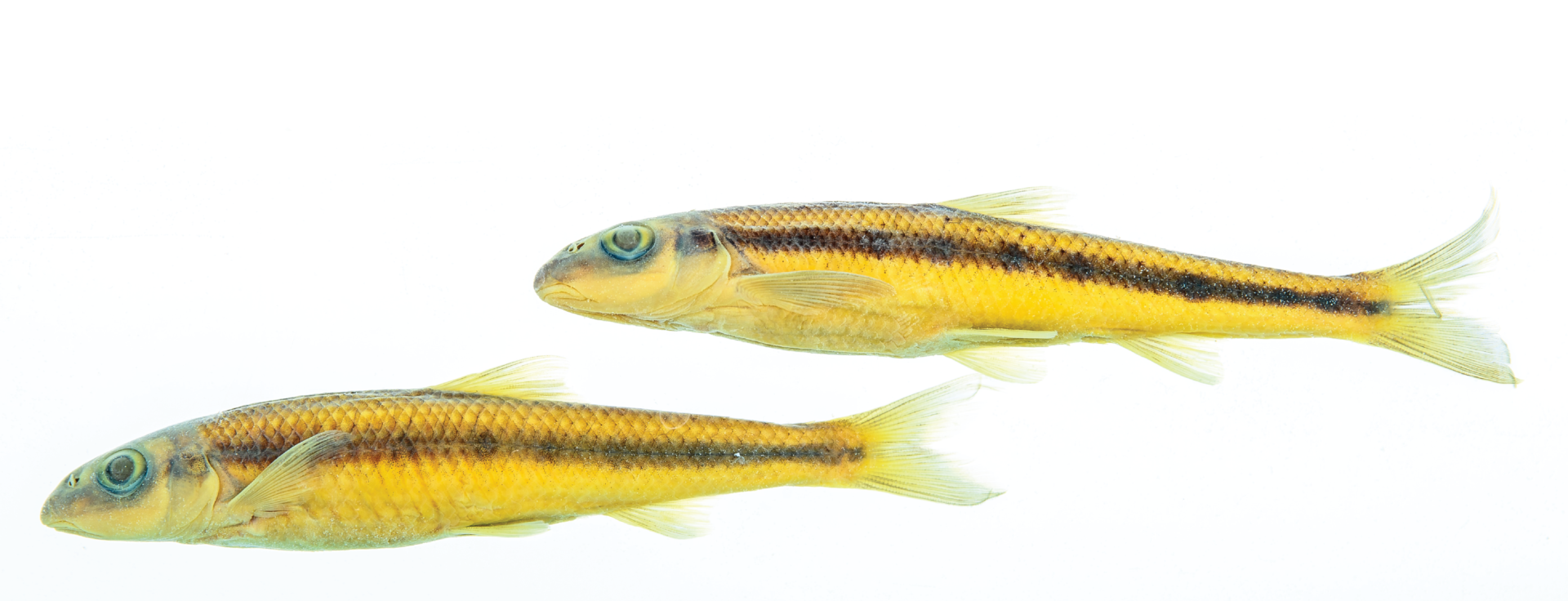
Ichthyology is the study of fish, including bony fish, cartilaginous fish, and jawless fish.
The fish collection at the Bell Museum of Natural History dates to the 19th century and contains over 41,000 cataloged lots. Early collections focused on fishes of the upper Midwest, especially fishes of Minnesota. However, there are many older collections from outside the state. These include specimens from the Menage expedition to the Philippines in the 1890s; fish from Hawaii collected in the early 1900s; and many other specimens from across the continental United States.
The fish collection also holds diverse holdings of marine fishes from the Pacific Northwest, Gulf of Mexico, and Atlantic coast. While most of the specimens are stored in alcohol there is: a large collection of pharyngeal teeth from cyprinids and catostomids; a sizable, uncataloged larval fish collection; and a growing collection of dry and stained-and-cleared skeletal material.
Minnesota Biodiversity Atlas
The Minnesota Biodiversity Atlas is a searchable, public database of animal, plant, and fungal specimens collected from all 87 Minnesota counties. With more than two million records and 500,000 images, this publicly available resource continues to grow.
Minnesota is home to the convergence of the three largest ecosystems in North America: broadleaf forest, prairie, and boreal forest. More than 9,000 different species reside here and records dating from the 19th century up to the present are hosted in the Minnesota Biodiversity Atlas.
Funding for the Atlas is provided by the Minnesota Environment and Natural Resources Trust Fund as recommended by the Legislative-Citizen Commission on Minnesota Resources (LCCMR).
How to request a loan
Zoological Collections loan requests will be evaluated based on merit, potential for specimen damage, and availability and condition of specimens.
Allow at least 4 weeks for approval and processing.
- Search the Bell Museum Fish Collections on Arctos, and the Mollusk & Crustacean Collections in the Minnesota Biodiversity Atlas. Some helpful resources for understanding Arctos search and results are at: https://arctosdb.org/about/quick-tour/
- Prepare the following:
- Your name, email, institution, mailing address, phone, and ORCiD (if requesting a research loan). If you are a student, postdoc, or support staff, also include this information for your PI.
- Project title
- Project abstract
- General methods including the type of data you expect to gather and where the data will be deposited (GenBank, MorphoSource, IsoBank, etc.). Destructive or consumptive requests must include explicit details regarding the amount and nature of material requested, expected damage to the specimens, and demonstration of successful methods for sampling and analysis of similar materials. Indicate who will be tasked with destructive sampling.
- List of specimens and parts you would like to borrow or sample, including whether there is taxonomic or geographic flexibility in the materials that would meet your project needs. Indicate how the Bell Museum specimens fit into your overall sampling scheme.
- A statement agreeing to credit the Bell Museum and specimens as outlined in the Loan Conditions below.
- Email your request to Fish and Invertebrate Curator Kassandra Ford (bellfish@umn.edu). If your request involves genetic work, please include Genetic Resources Curator Keith Barker (barke042@umn.edu). Please cc Collections Manager Angela Hornsby (horns076@umn.edu).
Loan recipients agree to the following conditions:
- At minimum, reference specimens by the full triplet catalog number (e.g., JFBM:Fish:1234) in all publicly available materials including articles, appendices, and databases. Where possible, complete GUID urls should be used (e.g., https://arctos.database.museum/guid/JFBM:Fish:1234).
- Credit the collections as: Bell Museum (University of Minnesota)
- Loans are made to institutions, not individuals. Do not subsample, alter, or transfer without written approval from the curator. Store specimens in a secure location with proper environmental controls. Notify the curator of specimen damage, misidentifications, and other concerns.
- Provide to the curator the DOI for each published article or product resulting from use of these specimens, and accession numbers or links to specimen data deposited in databases (GenBank, MorphoSource, IsoBank, etc.).
- Return specimens in the original condition and with the same or comparable packaging. Tissue and other consumptive loans do not need to be returned.